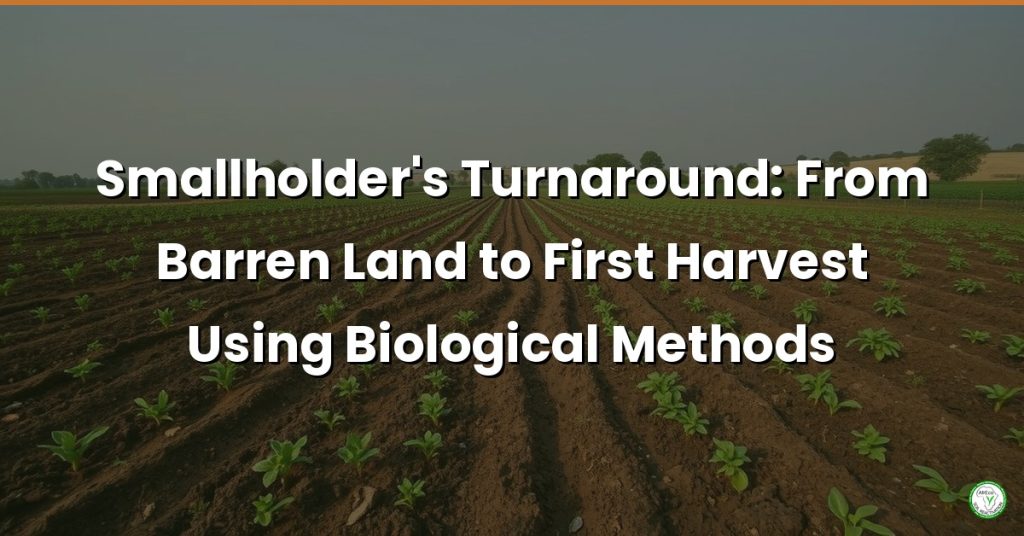
The Reality of Degraded Soil on Smallholder Farms
Many smallholder farmers face a familiar challenge: land that has lost its vitality through years of conventional practices. Ploughing destroys soil structure, chemical fertilizers suppress natural biology, and erosion strips away the precious topsoil layer. The result is land that requires increasing inputs to produce diminishing returns.
This degradation is not inevitable. Soil is a living entity that responds to how we treat it. When we understand the fundamental principles of soil health, we can reverse the damage and create a self-sustaining system that supports abundant plant growth.
The journey from barren to productive begins with understanding what healthy soil actually looks like. It is not merely dirt or a medium for holding plant roots. Healthy soil is a complex ecosystem with precise proportions that work together to support life.
The Healthy Soil Profile: A Precise Balance
A truly healthy soil profile contains specific components in exact proportions. Minerals make up 45% of the volume, providing the structural foundation. Water occupies 20-30% of the space, essential for nutrient transport and biological activity. Air fills another 20-30%, allowing aerobic organisms to thrive and roots to breathe.
The remaining 5% consists of organic material, which is often below 2% in degraded soils. This organic fraction is disproportionately important because it feeds the soil biology and improves water retention. Within this organic matter are collides, plates measuring just 0.002mm that result from organic breakdown and carry strong negative polarity for nutrient exchange.
Understanding these percentages provides a clear target for soil improvement. When any component falls out of balance, the entire system suffers. The goal is not to add more chemicals but to restore the natural equilibrium that allows plants to access what they need.
Understanding the Succession Scale and Soil Food Web
Soil biology follows a predictable progression known as the succession scale. Pioneer soil is dominated by bacteria, which break down organic matter rapidly. As the system matures, fungi become more prominent, creating stable aggregates and supporting deeper root penetration. The most advanced stage resembles forest soil, rich in fungal networks that create lasting structure.
The Soil Food Web represents the food chain of organisms living in this ecosystem. It begins with bacteria at the smallest level and progresses through fungi, protozoa, nematodes, earthworms, and arthropods. Each level feeds on the level below, creating a natural nutrient cycling system that has operated for millions of years.
The Theory of Soil illustrates how these organisms work together to maintain fertility. When we disrupt this web through ploughing and chemicals, we break the cycle. Restoring it requires reintroducing the missing organisms and allowing them to rebuild their relationships.
Reintroducing Life Through Compost Tea and Diverse Microorganisms
Compost Tea serves as a method to reintroduce aerobic organisms that depend on air flow for survival. These beneficial oxygenated organisms are essential for breaking down organic matter and making nutrients available to plants. When soil lacks proper aeration, these organisms cannot survive, and the system stagnates.
Diverse Microorganisms, also known as DMO, introduce organisms that thrive in low-oxygen environments. These anaerobic organisms work alongside aerobic ones to create a balanced soil biology. Together, they accelerate the succession scale, advancing soil from a bacteria-dominated state toward a more mature, fungi-rich condition.
The combination of these biological methods treats soil as a living entity rather than an inert medium. This approach avoids destructive practices and works with natural processes rather than against them. The result is soil that regenerates itself over time.
The Turnaround: From Understanding to First Harvest
The transformation begins with knowledge. The SOIL FUNDAMENTALS manual provides the essential understanding of how soil, plants, and nutrition interact. Without this foundation, biological methods become mere techniques without purpose. The manual explains the principles that make the difference between temporary fixes and lasting change.
Application guidance from the Bio-2 resource shows how to use organisms and natural composting effectively. Following these protocols allows smallholders to advance their soil biology systematically. The Calcium/Magnesium ratio, as described by Dr. Albrecht, plays a crucial role in controlling compaction and preventing erosion.
Within three seasons, farmers who adopt these methods report reduced fertilizer needs by approximately 35%. The soil becomes more resilient, holding water better and supporting stronger root systems. What began as barren land becomes a productive asset that improves with each passing season.
Take the Next Step
Ready to begin your own soil transformation journey? The SOIL FUNDAMENTALS manual provides everything you need to understand the principles behind biological soil management. Order your copy and start building healthy, self-sustaining soil on your farm.