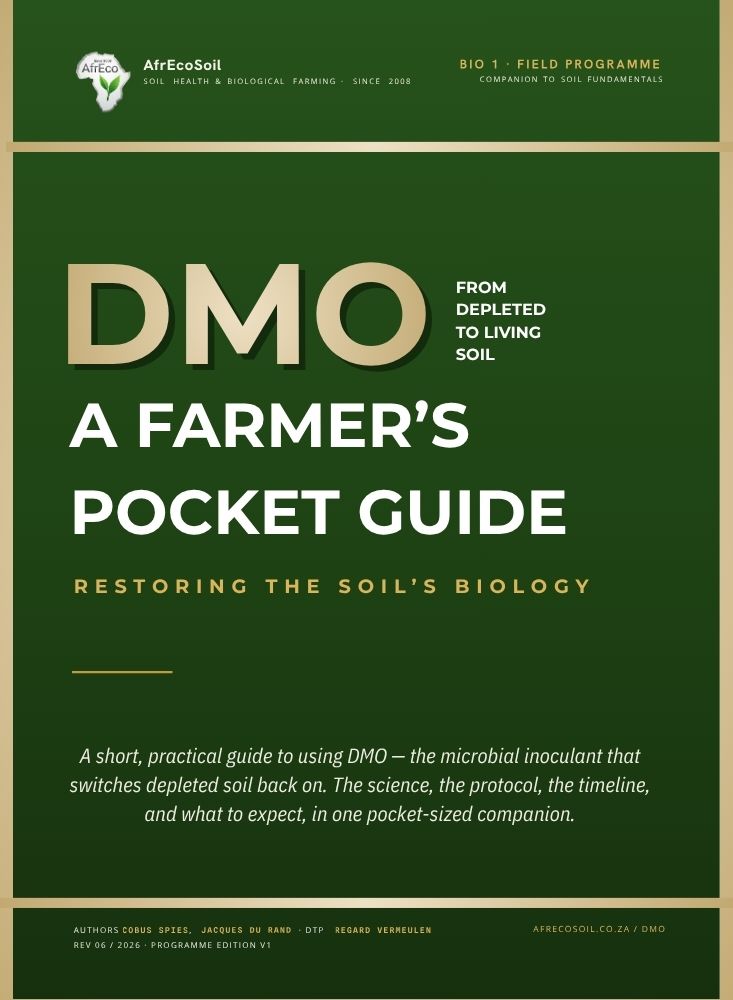
A Farmer’s Pocket Guide
The science, the protocol and the timeline of DMO — the microbial inoculant that switches depleted soil back on — in one short companion you can keep in the bakkie.
A field-ready companion to the 10-Week DMO Soil Revival Programme. Written for farmers, agronomists, and anyone working with depleted land.
Download the guide What’s inside
PDF · A4 · 17 pages · Free
Pocket-sized. Field-tested.
A short, practical guide to using DMO on depleted soil — built to be carried, not shelved.
The Farmer’s Pocket Guide is a companion to the AfrEco 10-Week DMO Soil Revival Programme. Where the programme gives you the week-by-week field practice, the Pocket Guide gives you the underlying logic: what depleted soil actually is, what DMO contains, how the biology unfolds once it goes in, and what to expect from the soil month by month.
It is written for the farmer first. Plain language, short sections, no jargon left unexplained. Read it once to understand the shape of the work, then reach for it whenever you need to plan an application, recognise a sign in the field, or explain to someone else why biology — not chemistry — is the leverage point.
“Your soil remembers how to be fertile. DMO helps it remember faster.”
Seventeen short pages.
Built in four parts — the problem, the product, the cascade, and the protocol — followed by South African context, integration, economics and FAQs.
- 01The hidden crisisThree layers of depletion: chemical, biological, structural.
- 02What is DMO?A microbial inoculant, not a fertiliser. What it is, and what it isn’t.
- 03The four microbial groupsPhotosynthetic bacteria, lactic acid bacteria, yeasts and fungi, actinomycetes — and the job each one does.
- 04The biological cascadeHow DMO triggers a three-phase recovery instead of just adding microbes to dirt.
- 05Phase 1 — ColonisationDays 1–14: the first two weeks set the foundation.
- 06Phase 2 — ActivationWeeks 2–8: the soil’s own systems come back online.
- 07Phase 3 — EcosystemMonths 2–6: mycorrhizal networks, food web, organic matter.
- 08Initial restoration applicationThe 10-week boom-spray protocol: rates, dilutions, preparation.
- 09Maintenance & foliar applicationHow to keep the rhythm once the soil is alive.
- 10The restoration timelineMonth-by-month signs, from week two to year two.
- 11In South African conditionsDrought, input costs, pest pressure, commercial timelines.
- 12Integrating regenerative practicesCover cropping, reduced tillage, organic matter, rotation.
- 13The economicsWhat it costs, what it saves, and the second-year picture.
- 14Common questions about DMOThe questions farmers ask first.
Diagrams and tables throughout. Designed to fold open on a tailgate.
The solution isn’t more chemistry. It’s biology.
A short orientation before you open the guide — just enough to give the rest a frame to hang on.
After years of intensive chemical agriculture, many South African farmers face the same picture: inputs rise, yields plateau, water runs off, pest pressure grows. The soil that should be a living asset has become an inert growing medium.
Depleted soil isn’t simply low in nutrients. It is switched off on a biological level — the workforce that cycles nutrients, holds water, builds structure and suppresses disease is no longer there. Adding more fertiliser to soil in that state is like pouring premium fuel into an engine with no spark plugs.
DMO is the spark. It is a concentrated microbial inoculant — a synergistic blend of four groups of organisms that re-seed the soil’s biology and trigger a cascade: colonisation in the first two weeks, activation across the next two months, full ecosystem re-establishment within six. It does not replace regenerative practice; it accelerates it, often turning a decades-long natural recovery into one a commercial farm can plan against.
Days 1–14. DMO organisms outcompete pathogens in the root zone.
Weeks 2–8. Nutrient cycling resumes, structure improves, disease pressure drops.
Months 2–6. Mycorrhizal networks rebuild, food web returns, organic matter accumulates.
The Farmer’s Pocket Guide. Yours to read, share and print.
The full 17-page guide as a single PDF — designed to read on screen, print on A4, or fold into a bakkie’s glove box. Enter your email below and we’ll send you the link.
In this download
- A clear picture of what depleted soil actually is.
- What DMO contains, and what each microbial group does.
- The three-phase biological cascade, days to months.
- Boom-spray rates, dilutions and timing for the 10-week protocol.
- A month-by-month picture of what to expect from the soil.
- How DMO sits alongside cover cropping, reduced tillage and rotation.
- An honest look at the economics, and the questions farmers ask first.
For the field practice — the weekly assessment, the application log, the signs of returning balance — pair this with the 10-Week DMO Soil Revival Programme.