Soil Fertility — Beyond Chemicals
Grow the soil. Let the soil grow the plant.
Soil isn’t dirt — it’s a living microbiome. This is biological soil fertility: a regenerative, evidence-based alternative to conventional fertilizer programmes, written for South African land. Feed and balance the living soil, and the chemistry of fertility largely takes care of itself.
R750 · 73-page manual · fully referenced
Get the book · R750First edition · instant PDF download — available now.
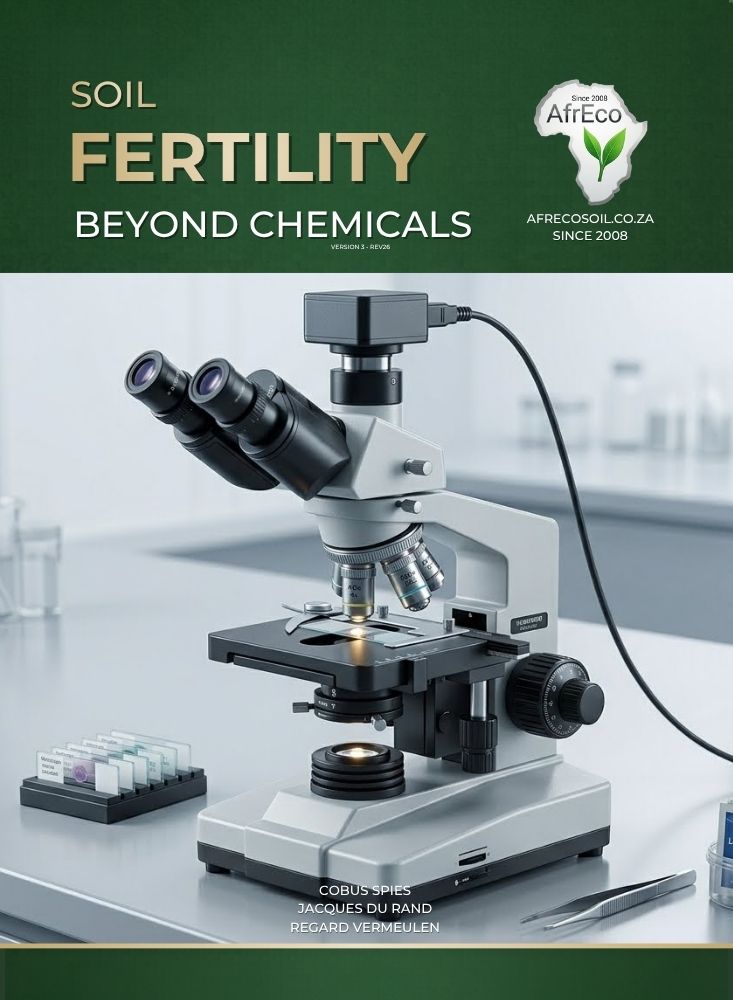
Fertility is biological before it is chemical.
For decades, soil fertility was treated as an equation of bags — nitrogen, phosphate and potassium by the hectare. It works for a season, but it erodes the very thing that makes land productive: the living soil. As biology declines, soils compact, hold less water, lock up minerals, and demand ever more fertilizer for the same yield.
This book takes the opposite path. The farmer’s real job isn’t to feed the plant — it’s to grow the soil, and let the living soil grow the plant. Inputs become amplifiers of a healthy system, not a crutch. The result is living, self-feeding soil, lower input costs, and more resilient crops.
Eleven chapters, in two parts
From how soil works to the biology that drives it — international soil science, translated for South African land.
Part One · The Soil
- 01 · Soil Fertility
- 02 · Crop Production Potential
- 03 · Soil Classification
- 04 · Soil Sampling
- 05 · Soil Analysis
- 06 · Soil Organic Matter & the Carbon Cycle
- 07 · Soil Water
Part Two · Soil Biology
- 08 · The Soil Biome
- 09 · Mycorrhizal Fungi
- 10 · Seaweed Extracts
- 11 · Bio-Activators
Reference — a complete Glossary & Master Bibliography.
Read your land — and know exactly what to change.
- Understand what soil fertility really is — and why combining organic and mineral inputs beats either one alone.
- Benchmark your land’s true production potential and find the gap you can actually close.
- Read your soil’s classification as a management forecast.
- Sample and interpret a soil analysis properly — including the biological indicators most tests ignore.
- Build organic matter and manage water as the master levers of a dryland system.
- Work with the soil biome — bacteria, fungi, earthworms — and the mycorrhizal partnership that feeds your crop.
- Use seaweed extracts and bio-activators honestly, as amplifiers of a healthy system rather than a crutch.
Prefer to start in the field first? Take the free soil self-assessment, or read what DMO is.
For growers who want to understand, not just apply.
Written for commercial and emerging farmers, agricultural students, and anyone done treating symptoms instead of causes. Plain-language and fully referenced — every chapter closes with its principle, the science, the South African context, the practice, and key takeaways.
Your soil deserves better. This is where it starts.
Soil Fertility — Beyond Chemicals. 73 pages, fully referenced.
Get the book · R750First edition · instant PDF download — available now.