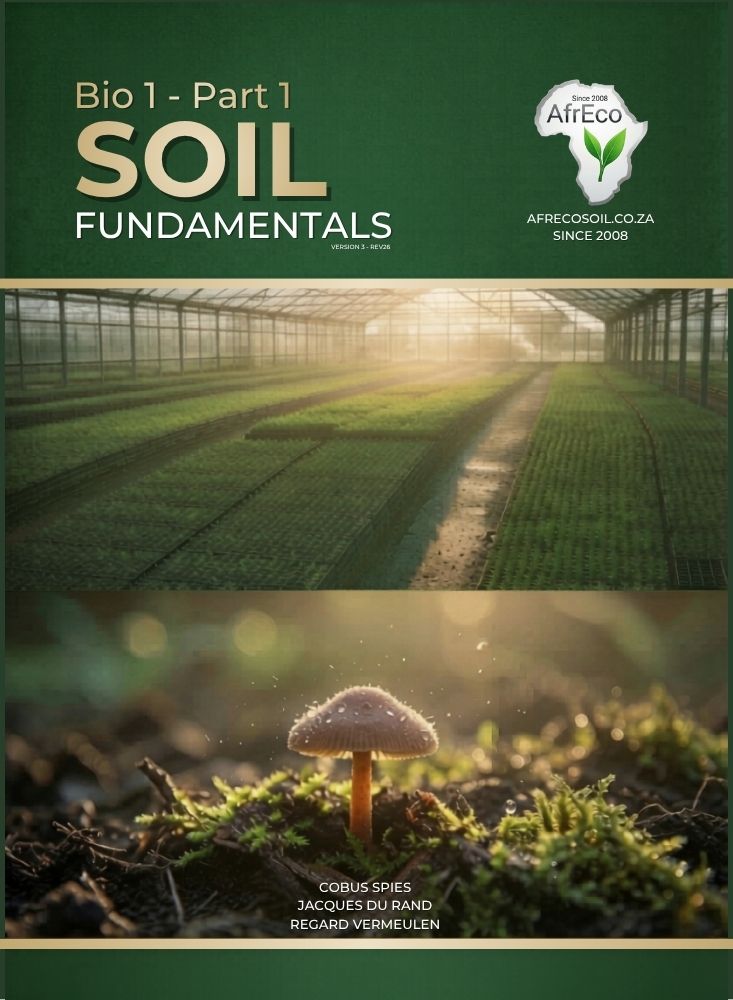
Soil Fundamentals
A plain-language field manual on the living system beneath every crop — and the practice of farming with it instead of against it.
Built on AfrEco’s field experience since 2008. Written for farmers, growers and anyone willing to look closely at the ground.
PDF · A4 · 51 pages · Bio 1 series
A starting point, not a recipe.
Most farming guides hand you a programme. This one hands you a way of seeing — so the programmes that follow actually make sense.
Soil Fundamentals is the first module in the AfrEco Bio 1 series. It steps back from the day-to-day of inputs and applications and asks a simpler question: what is healthy soil, actually?
The manual works from the ground up. It looks at the physical make-up of a soil profile, the organisms that live inside it, and the quiet relationships between soil, water, minerals and the plant. It also explains, without finger-pointing, how decades of conventional practice change that picture — and what a different starting point looks like.
By the end you won’t have a prescription. You’ll have something more useful: a working mental model of your own soil, and the vocabulary to talk about it with confidence.
“Feed the soil, and the soil feeds the plant.”
Inside the manual.
Twelve short chapters, building from the structure of healthy soil to a practical assessment of your own land. Each chapter stands on its own; together they form one continuous argument.
- 01A healthy soil profileWhat healthy soil is actually made of, and the small fraction that matters most.
- 02The succession scaleWhere every soil sits on the path from bare ground to mature ecosystem.
- 03Micro-organismsThe invisible workforce: why soil without life is just dust.
- 04The soil organismsA short guide to who lives down there, and what each group does.
- 05An active soil profileWhat it looks like when the system is working as it should.
- 06A deactivated soil profileHow soil “switches off”, and how to recognise it on your land.
- 07Root developmentA side-by-side look at how soil condition shapes what plants can do.
- 08Types of soil organismsBacteria, protozoa, nematodes, actinomycetes and fungi, and what each one does for the crop.
- 09Natural compostingHow nature builds fertility for free, and how to work with that process.
- 10Deactivated soil conditionThe cost of keeping soil on life support, season after season.
- 11General soil assessmentA practical walk-through for evaluating the soil on your own land.
- 12What to do nextWhere to start, what to measure, and how Bio 1 leads into Bio 2 and Bio 3.
Plain language throughout. Field diagrams and photographs on every chapter. Ends with a self-assessment you can apply on your own land.
How soil works, in two minutes.
A high-level overview before you open the manual — just enough to give the rest a frame to hang on.
Healthy soil isn’t a substrate; it’s a living system. A balanced soil profile is roughly half solid, half open space — minerals and a small amount of organic matter on one side, air and water filling the gaps on the other.
That open structure is what lets roots breathe and reach, what lets water move and be held, and what gives the soil’s real workforce — bacteria, fungi, protozoa, nematodes and the rest — somewhere to live.
Those organisms are the soil’s digestive system. They break organic material down into the minerals plants can actually take up, and they hold those minerals in place until a root comes calling. Plants, in turn, feed sugars back into the soil to keep the workforce fed. It’s a closed loop — when it’s running.
When that life is removed — by tillage, by harsh inputs, by neglect — the loop breaks. The soil deactivates: it compacts, it loses its ability to hold water, and the plant becomes entirely dependent on whatever you put on it next. The manual is, in the end, about how to keep that loop running.
Minerals, water, air and organic material in balance.
Bacteria, fungi and other organisms move in.
Organic matter is broken down into plant-available minerals.
Plants feed sugars back to the soil. The loop continues.
Soil Fundamentals. Yours to read, share and print.
The full 51-page manual as a single PDF — designed to read on screen or print on A4. The first module of the AfrEco Bio 1 series.
PDF · A4 · 51 pages · Bio 1 · 2026
- A clear picture of what healthy soil actually is.
- A working understanding of the soil food web.
- Why some soils “switch off” — and what that costs.
- How root development reflects soil condition.
- A practical assessment for your own land.
- A pointer to what comes next in the Bio 1 series.